


Ask the Experts24/7 Online Support
Ask the Experts24/7 Online Support
 August 18, 2026 14:59PM
 0 Comments | Post a Comment

LOCO Posted on [ Aug 18, 2026 14:59PM ]
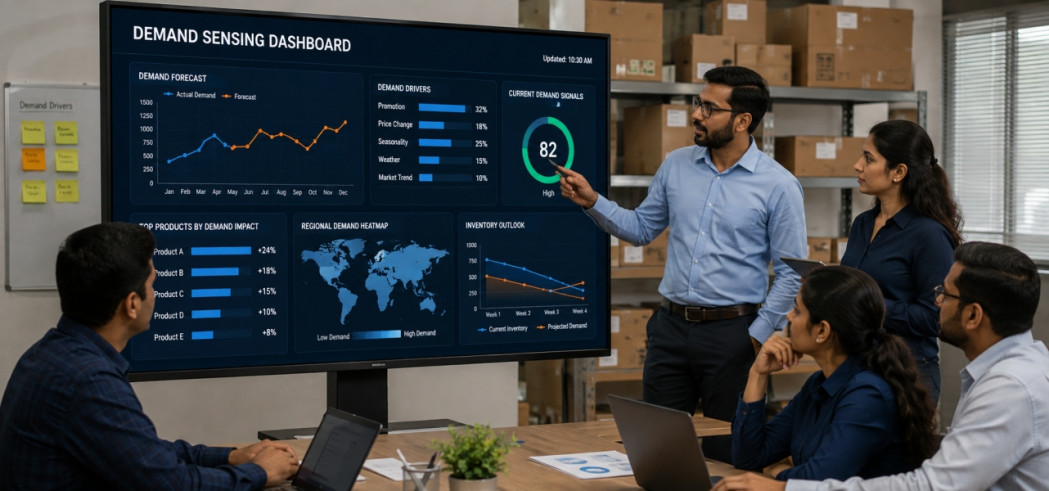
Demand Sensing: The Next Evolution in Supply Chain Forecasting
Accurate demand forecasting is essential for efficient supply chain management. Businesses need to know what customers are likely to buy, when demand will increase, and how much inventory should be available.
Traditional forecasting methods often depend on historical sales data and fixed planning cycles. However, customer demand can change rapidly because of promotions, weather, market trends, economic conditions, competitor activity, and changing consumer behaviour. Demand sensing uses real-time and near-real-time information to identify changes in demand and help businesses respond faster.
What Is Demand Sensing?
Demand sensing is an advanced forecasting approach that combines historical information with current market signals to improve short-term demand predictions.
Instead of relying only on previous sales patterns, demand sensing can analyze data such as:
The objective is to identify changes in demand as they happen rather than waiting for traditional forecasting cycles.
Traditional Forecasting vs Demand Sensing
Traditional forecasting generally uses historical demand patterns to predict future requirements. While this approach remains useful for long-term planning, it may not react quickly to sudden changes.
Demand sensing adds real-time signals to the forecasting process. For example, if demand for a particular product suddenly increases because of a promotion or changing consumer trend, demand sensing technology can detect the change and help supply chain teams adjust replenishment plans.
Role of AI and Machine Learning
Artificial intelligence and machine learning are important technologies behind modern demand-sensing systems.
AI models can process large volumes of structured and unstructured data, identify patterns, and continuously improve forecasts. Machine learning can also identify relationships between demand and external factors that may be difficult to detect through manual analysis.
Benefits of Demand Sensing
Better Forecast Accuracy
Using current market signals can help companies respond more quickly to short-term changes in customer demand.
Lower Inventory Costs
More accurate forecasts can help businesses avoid unnecessary stock while maintaining sufficient inventory for customers.
Fewer Stockouts
Improved visibility into demand can help businesses identify potential shortages earlier.
Better Production Planning
Manufacturers can adjust production schedules according to changing demand signals.
Improved Logistics Efficiency
Better demand information can help companies plan transportation, warehousing, replenishment, and distribution more effectively.
Demand Sensing Across Industries
Demand sensing can be useful across multiple industries, including retail, FMCG, automotive, pharmaceuticals, manufacturing, electronics, and e-commerce. For fast-moving consumer products, where demand can change quickly, real-time signals can be particularly valuable.
Challenges
Despite its potential, demand sensing requires reliable data and strong technology infrastructure.
Common challenges include:
Companies should therefore focus on data integration and process improvement alongside technology adoption.
The Future of Supply Chain Forecasting
Demand sensing is moving supply chain forecasting from a primarily historical process toward a real-time, adaptive model.
As AI, IoT, cloud platforms, digital commerce, and connected supply chains continue to develop, businesses will have access to more demand signals than ever before. The future supply chain will increasingly respond to what customers are doing now, rather than relying only on what they purchased in the past.
Conclusion
Demand sensing represents an important evolution in supply chain forecasting. By combining historical data with real-time market signals, businesses can improve demand visibility, inventory planning, production decisions, and logistics efficiency. The goal is not to completely replace traditional forecasting but to make it more responsive and accurate.
Customer Reviews (0 )
No record(s) Found !
 Categories