


Ask the Experts24/7 Online Support
Ask the Experts24/7 Online Support
 August 13, 2026 21:10PM
 0 Comments | Post a Comment
LOCO Posted on [ Aug 13, 2026 21:10PM ]
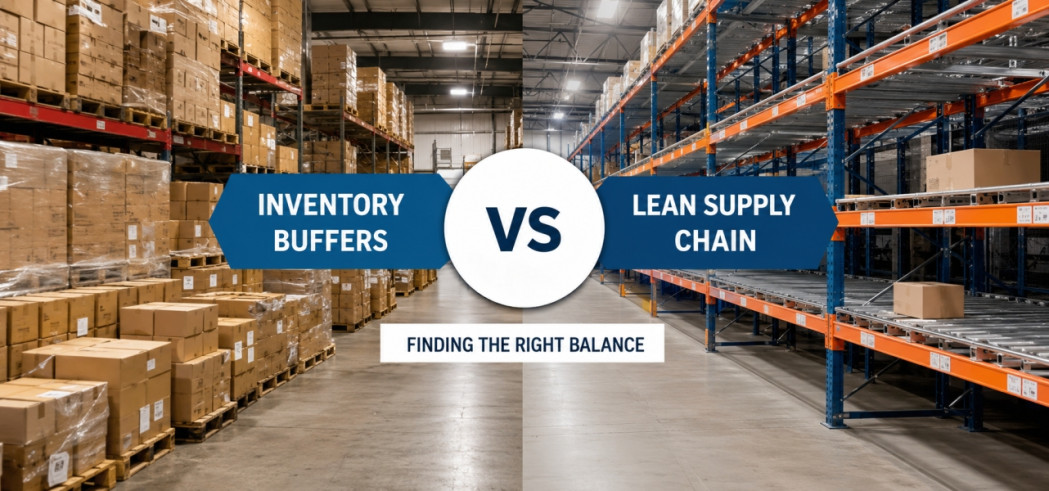
Inventory Buffers vs Lean Supply Chains: Finding the Right Balance
Inventory management is one of the most important decisions in modern supply chain management. Businesses need enough stock to meet customer demand, but holding too much inventory can increase storage costs, working capital requirements, and the risk of obsolete products.
This creates an important strategic question: Should companies maintain inventory buffers or follow a lean supply chain model?
The right answer is rarely at either extreme. Modern businesses increasingly need a balanced approach that combines lean operations with carefully planned inventory buffers.
What Are Inventory Buffers?
Inventory buffers, also known as safety stock, are additional quantities of products or materials maintained to protect businesses against unexpected demand increases, supplier delays, transportation disruptions, or production problems.
For example, a manufacturer may maintain additional raw materials because a critical supplier could experience a delivery delay. Similarly, a retailer may hold extra stock before a major seasonal sales period.
Benefits of Inventory Buffers
However, excessive inventory can create higher warehouse costs and tie up capital.
What Is a Lean Supply Chain?
A lean supply chain focuses on eliminating waste and maintaining only the inventory required to support efficient operations. The objective is to improve flow, reduce unnecessary costs, and deliver products with minimal resources.
Just-in-Time (JIT) inventory is a well-known example of a lean approach, where materials arrive close to the time they are required for production.
Benefits of Lean Supply Chains
The main risk is that extremely low inventory levels can leave companies vulnerable when unexpected disruptions occur.
Why Balance Is Important
Recent supply chain disruptions have demonstrated that efficiency alone is not always enough. Port congestion, geopolitical events, extreme weather, supplier failures, and sudden changes in consumer demand can affect supply networks.
At the same time, maintaining excessive inventory everywhere is expensive and inefficient.
Businesses therefore need to identify which products and materials require protection and which can be managed with lean inventory levels.
How Companies Can Find the Right Balance
1. Classify Inventory
Businesses can classify products according to value, demand, criticality, and supply risk. High-value or business-critical materials may require different inventory policies from low-risk products.
2. Analyze Demand Volatility
Products with unpredictable demand may require higher safety stock, while products with stable demand can often be managed with leaner inventory.
3. Evaluate Supplier Reliability
Companies should consider supplier lead times, historical performance, geographical risks, and availability of alternative suppliers when determining inventory requirements.
4. Use Technology
AI, demand forecasting, inventory analytics, and supply chain management platforms can help businesses determine appropriate inventory levels.
Real-time data can also help companies adjust safety stock when market conditions change.
The Future of Inventory Management
The future will not be about choosing between completely lean or heavily buffered supply chains. Instead, businesses will increasingly adopt dynamic inventory strategies.
AI-powered forecasting can help determine where buffers are necessary and where inventory can be reduced. Digital supply chain platforms can provide real-time visibility into demand, inventory, transportation, and supplier performance.
Conclusion
Inventory buffers and lean supply chains are not competing strategies—they can complement each other. A resilient supply chain should remain efficient while maintaining enough protection against critical risks.
The ideal inventory strategy depends on product demand, supplier reliability, lead times, customer expectations, and disruption risks. By combining data-driven forecasting, inventory segmentation, supplier diversification, and carefully calculated safety stock, businesses can achieve a stronger balance between cost efficiency and supply chain resilience.
Customer Reviews (0 )
No record(s) Found !
 Categories