


Ask the Experts24/7 Online Support
Ask the Experts24/7 Online Support
India |
August 17, 2026 | 15:05 PM
Loco News Bureau : India's growing trade and manufacturing ambitions have increased the need for a strong domestic container manufacturing base. The proposed Container Manufacturing Assistance Scheme (CMAS), backed by a ₹10,000 crore outlay, seeks to promote manufacturing, investment and technology development across the container ecosystem. With broader reforms in shipping, ports and logistics, the initiative is expected to strengthen India’s maritime capabilities, generate employment and support India's long-term trade competitiveness.
The Need for Domestic Container Manufacturing
Global trade today is increasingly driven by containerised logistics. According to the United Nations Conference on Trade and Development (UNCTAD), around 80% of global merchandise trade by volume is transported by sea. Maritime transport forms the backbone of international commerce. Meanwhile, containerised cargo accounts for nearly two-thirds of the value of international trade. These trends highlight the strategic importance of efficient container logistics in supporting global supply chains.
In recent years, geopolitical tensions, supply-chain disruptions and changing shipping routes have exposed vulnerabilities in the global movement of goods. UNCTAD has observed that these disruptions have contributed to freight-rate volatility and increased pressure on maritime transport networks. As a result, many countries are placing greater emphasis on enhancing domestic manufacturing capabilities for critical logistics assets, including shipping containers.
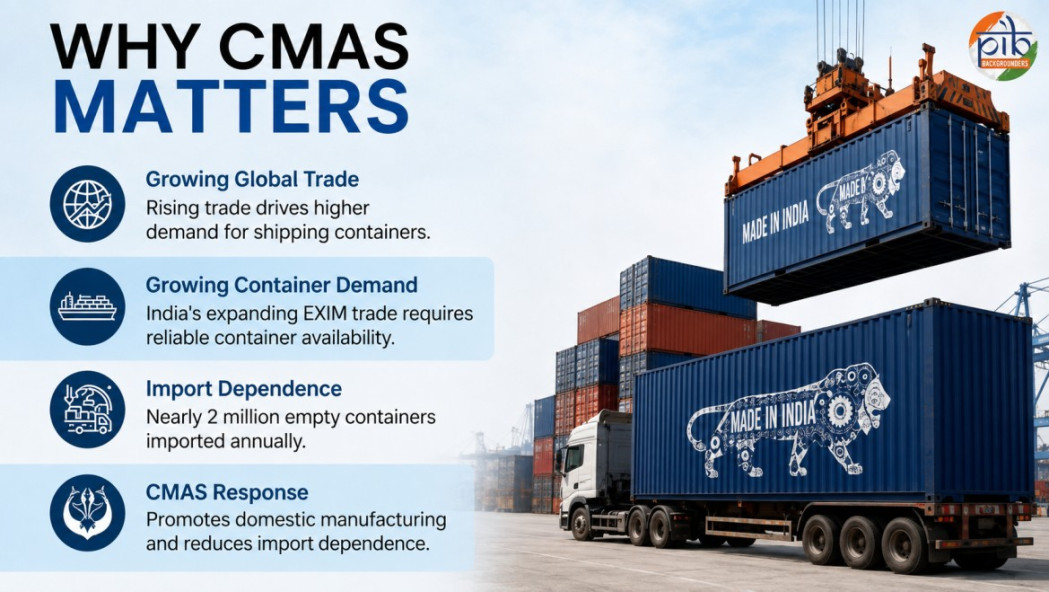
India's growing role in global manufacturing and international trade has significantly increased the demand for containerized cargo movement. However, despite expanding export-import (EXIM) trade and rapid logistics development, India has largely depended on imported empty containers. India imports nearly 2 million empty containers every year to meet domestic demand and for repositioning purposes. This has made container availability vulnerable to global market fluctuations, freight volatility and supply-chain disruptions.
Recognizing these emerging challenges, the Government announced the Container Manufacturing Assistance Scheme (CMAS). It aims to establish a globally competitive container manufacturing ecosystem in India by promoting domestic manufacturing and encouraging investment across the value chain. The initiative also seeks to reduce import dependence and strengthen supply-chain resilience. Further, it complements the Government's initiatives under Make in India, Maritime Amrit Kaal Vision 2047 and multimodal logistics development, contributing to India's long-term maritime and trade ambitions.
What is Container Manufacturing Assistance Scheme (CMAS)?
CMAS was announced in the Union Budget 2026–27. It is a targeted initiative to establish a competitive domestic container manufacturing industry through financial and institutional support.
With an outlay of ₹10,000 crore over five years, the proposed scheme supports establishment of new manufacturing facilities and expansion of existing units. It also aims to enhance manufacturing capacity to meet India's growing demand for shipping containers.
The initiative targets an annual domestic manufacturing capacity of around 10 times the existing container production capacity upto 7.5 lakh Twenty-foot Equivalent Units (TEUs). It is expected to generate a market opportunity of nearly ₹80000 lakh crore while positioning India as a reliable producer of internationally competitive shipping containers.
To strengthen the container manufacturing value chain, the scheme provides:
CMAS is one element of a broader strategy to build an integrated, domestically anchored container ecosystem. In February 2026, the Ministry of Ports, Shipping and Waterways signed an MoU to establish the Bharat Container Shipping Line (BCSL). This brings together the Shipping Corporation of India (SCI), the Container Corporation of India (CONCOR), the Jawaharlal Nehru Port Authority, V.O. Chidambaranar Port Authority (VOCPA) and the Sagarmala Finance Corporation Limited (SFMCL). The initiative envisages investments of around ₹99,149 crore in fleet development of 51 container vessels of various sizes and domestic container procurement.
This coordinated approach complements the Government's wider logistics initiatives. These include:
· PM Gati Shakti, enhancing connectivity between ports, railways, highways and industrial centres;
These initiatives support a resilient and integrated logistics network for India's growing trade volumes.
Employment and Manufacturing Opportunities
Beyond improving logistics resilience, CMAS is expected to generate substantial employment and stimulate industrial development.
It has the potential to generate around 3,000 direct jobs and more than 50,000 indirect jobs across container manufacturing and allied industries.
What are Containers?
Shipping containers are standardized steel freight containers used to transport cargo across ships, railways and road vehicles without unloading and repacking the goods during transit. Built to internationally recognised ISO (International Organization for Standardization) specifications, they enable seamless intermodal transport and efficient global trade. The most common sizes are 20-foot and 40-foot containers, measured in Twenty-foot Equivalent Units (TEUs), the standard unit used to measure container capacity.
The initiative is also expected to catalyse growth across several ancillary industries, including:
Recent Progress and Industry Response
In July 2026, India achieved a significant milestone in maritime manufacturing with the rollout of its first India-manufactured export-import (EXIM) shipping container for global shipping company, A.P. Moller–Maersk. The container was unveiled at the Maersk–CONCOR Inland Container Depot in Dadri, Uttar Pradesh.
The container has been manufactured in accordance with internationally recognised ISO standards and the International Convention for Safe Containers (CSC). This makes it suitable for deployment across global shipping networks. The rollout demonstrates India's capability to manufacture globally compliant shipping containers.
Another notable milestone was Maersk's order for 1,000 additional Made-in-India shipping containers with DCM Shriram Group. The order represents an early commercial endorsement of India's emerging manufacturing capability. It also signals growing confidence among global shipping companies in India's ability to produce high-quality shipping containers.
These developments indicate that the Government's policy interventions are beginning to translate into commercial outcomes. They also reinforce India's ambition to emerge as an important manufacturing hub within the global maritime value chain.
Comments (0)
No record(s) Found !