


Ask the Experts24/7 Online Support
Ask the Experts24/7 Online Support
India |
August 25, 2026 | 16:01 PM
Loco News Bureau :
Introduction
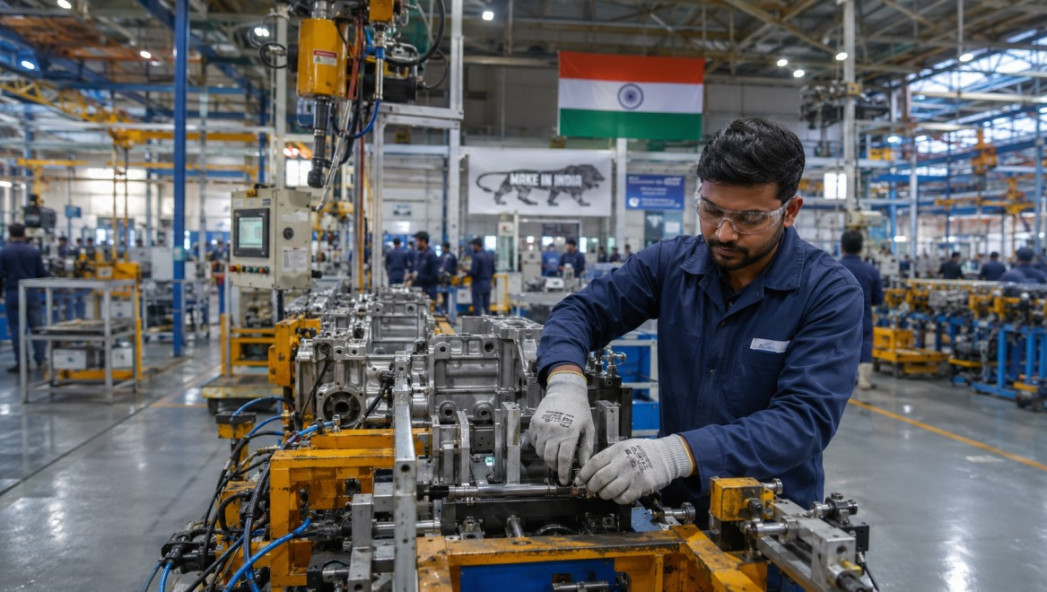
As India celebrates its 80th Independence Day, the nation’s manufacturing sector stands as a pillar of self-reliance and progress. Over the past 12 years, bold reforms under the Make in India vision have reshaped industries, positioning the country as a global hub. Defence equipment, textiles, pharmaceuticals, medical devices, and heavy machinery are now produced at world-class standards, serving both domestic and international markets. To further accelerate this momentum, the Government has introduced several initiatives like the Production Linked Incentive (PLI) scheme, PM GatiShakti, the National Logistics Policy, BHAVYA, and programmes for the electronics and MSME sectors.
Strengthening India’s Manufacturing Ecosystem
The manufacturing sector now contributes about 16–17 percent of GDP and employs over 27 million workers. The compounded annual growth rate (CAGR) of Manufacturing GVA at constant prices (2022-23 base) as per the revised series during 2022-23 to 2025-26 is 10.88%. Merchandise exports in July 2026 reached USD 44.24 billion, compared to USD 36.98 billion a year earlier, while manufacturing output grew 7.8 percent in June 2026. These indicators show manufacturing as a central driver of India’s economic growth.
India’s Defence Transformation: From Self-Reliance to Global Exports
India’s defence industry has undergone a remarkable transformation in the past decade. Focused policies, targeted investments, and a strong push for self-reliance have turned the country into a significant producer and exporter of defence equipment.
Key Facts:
India’s Electronics Boost
India has rapidly evolved into a major centre for electronics production, achieving exceptional growth in both output and exports. Successive policies like the National Policy on Electronics, SPECS, EMC 2.0, and PLI have reshaped electronics manufacturing. Schemes such as Electronics Components Manufacturing Scheme (ECMS) further strengthened India’s Electronics System Design and Manufacturing (ESDM) ecosystem, driving growth and competitiveness. Electronics production rose from ₹11.32 lakh crore in FY 2024–25 to ₹13.11 lakh crore in FY 2025–26, a 15.8% year-on-year increase.
Semicon Manufacturing
India's emergence as a semiconductor destination has been built on sustained reforms across the electronics sector. The Semicon India Programme (Semicon 1.0) was approved in December 2021 with an outlay of ₹76,000 crore. It was launched to build a domestic semiconductor and display manufacturing ecosystem. Building on it, Semicon 2.0 has been approved in July, 2026 with a total budget outlay of ₹1,27,500 crore.
Progress Under Semicon India Programme 1.0
As of July 2026, twelve manufacturing units have been approved with investments exceeding ₹1.64 lakh crore. These include one silicon fab, one silicon carbide fab, an integrated Gallium Nitride Micro LED display fab, and nine packaging units. Together, they are expected to meet chip requirements across consumer appliances, industrial electronics, automobiles, power electronics, telecommunications, and aerospace.
Out of the twelve approved proposals, three companies, Micron, Kaynes, and CG Semi have already started commercial production. One more company is expected to begin operations in 2026, further strengthening India’s semiconductor manufacturing base.
India’s Mobile Manufacturing Rise
India’s mobile manufacturing sector has grown rapidly, strengthening domestic production, exports and value addition.
Mobile Phone Manufacturing Scheme:
This scheme was approved on July 15, 2026, with a ₹62,500 crore budget. It focusses on boosting production, domestic value addition, supply chain resilience and global competitiveness. The five-year scheme will run from FY 2026–27 to FY 2030–31. Incentives range from 2.25% to 5%, with additional support for local sourcing, Indian brands, design and R&D.
India’s Pharma Edge: Scaling Manufacturing and Exports
India ranks 3rd in volume and 11th in value in the global pharmaceutical industry. It plays a crucial role in ensuring affordable healthcare worldwide by supplying 20% of the world’s generic medicines and a large share of vaccines. Steady growth in production, exports, and domestic innovation has reinforced its position as a trusted global supplier.
Comments (0)
No record(s) Found !